
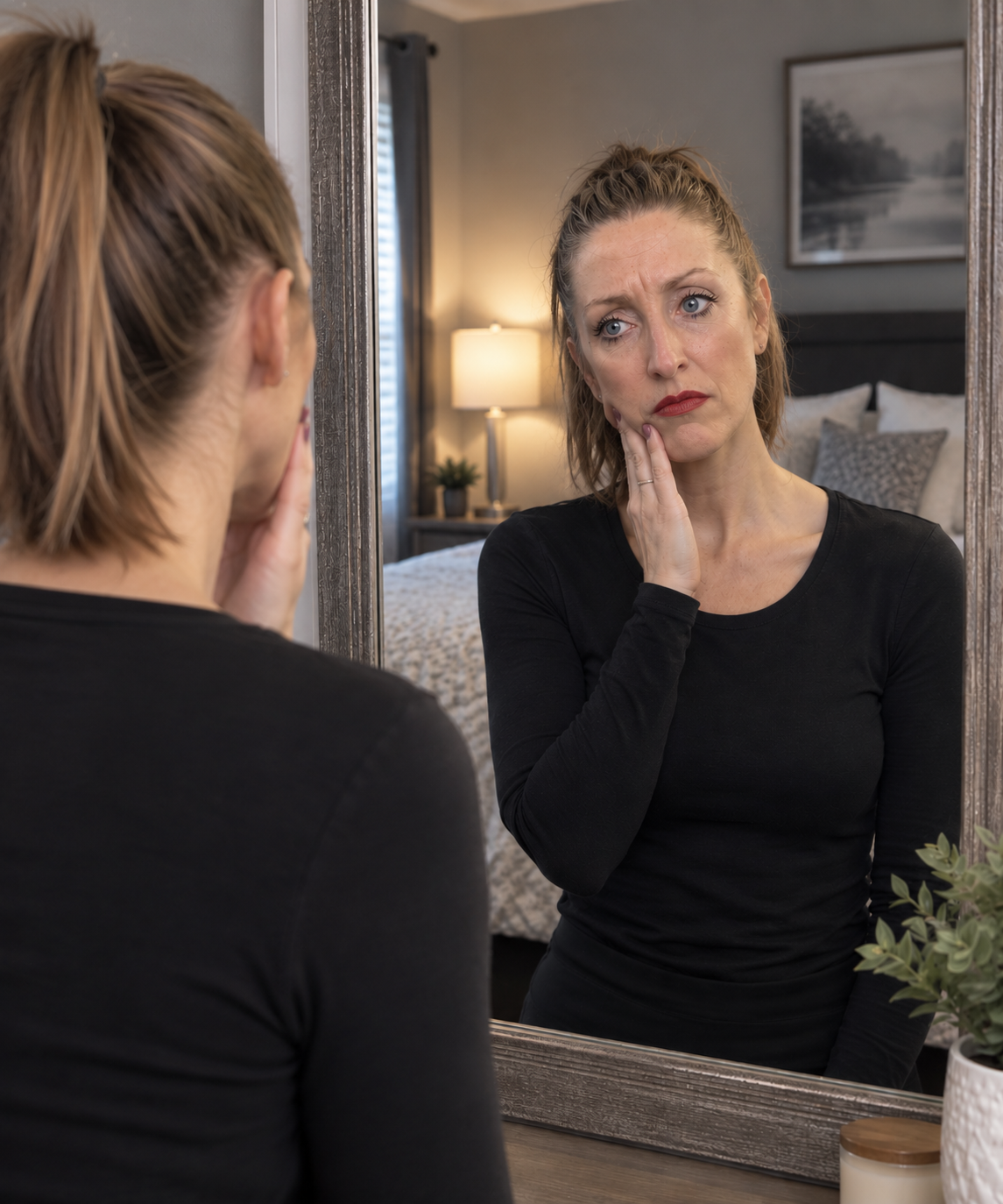
And why it has nothing to do with how well you are aging.
She was not someone who spent a lot of time worrying about how she looked.
She had never been that woman. Forty-something years of showing up fully, leading hard, caring deeply, and not spending much energy on the mirror.
And then one morning she looked at her reflection and something had changed.
Not dramatically. Not overnight. But in the quiet accumulation of small things she could not quite explain. Her skin felt drier than it used to despite drinking more water than ever. There were lines that had not been there a year ago that no amount of sleep seemed to touch. And her hair. Her thick, reliable hair that had never given her a moment’s trouble was thinning at the temples in a way she noticed every single morning and had not yet said out loud to anyone.
She Googled thyroid disorder. She bought new shampoo. She increased her water intake. She tried a new moisturizer.
None of it got to the root.
Because a big part of the root was hormonal. And nobody had told her.
The Connection Nobody Makes Soon Enough
Skin and hair changes are among the most commonly experienced and least discussed symptoms of perimenopause and menopause.
Women notice them. They manage them. They spend significant time and money trying to address them with products that treat the surface without touching what is underneath. And most of the time, nobody connects the dots for them between what they are seeing in the mirror and what is happening in their hormonal landscape.
This article is the conversation I wish every midlife woman had access to years before she starts Googling.
Because when you understand what is actually driving the changes, everything shifts. You stop blaming yourself for aging badly. You stop throwing money at products that cannot solve a physiological problem. And you start giving your body what it actually needs.
What Estrogen Was Doing All Along
To understand what is happening to your skin and hair now, you first need to understand what estrogen was quietly doing for decades.
Think of estrogen as your skin’s behind-the-scenes manager. It was the reason your skin held onto moisture. The reason it bounced back. The reason your hair grew in thick and strong and stayed that way. Estrogen was giving your body the signal to keep producing collagen, which is basically the scaffolding that keeps skin firm and plump. It was also telling your hair follicles to stay in their growing phase for longer, which is why your hair looked the way it did.
It was also keeping your skin hydrated from the inside, not just on the surface. Your body was producing its own natural moisture-holding compounds and skin oils that kept everything balanced without you ever having to think about it.
When estrogen starts to decline during perimenopause and menopause, all of those signals quiet down. Your skin stops getting the memo to produce as much collagen. Your hair follicles shift into a resting phase sooner. The natural moisture your skin was holding onto starts to slip.
None of this is your fault. None of it means you have been doing anything wrong. It means the hormonal signal that was running all of those processes in the background has changed. And your body needs a different kind of support now than it did five years ago. Research in JAMA Dermatology and a 2025 expert review published in PubMed both confirm how significant estrogen’s role in skin health truly is.
What Is Actually Happening to Your Skin
Dryness That Feels Deeper Than the Surface
The dryness most midlife women experience is not the kind that a richer moisturizer fixes. It comes from inside.
Your skin used to produce its own natural moisture from within. Estrogen was part of what made that happen. When estrogen drops, your skin loses that internal hydration mechanism and no amount of cream applied on top can fully replace what the body was doing from the inside out.
The result is skin that feels persistently dry, sometimes tight, sometimes itchy, in a way that catches you off guard because you have never experienced your skin behaving quite like this before.
What actually helps is feeding your skin from within. Foods rich in healthy fats like salmon, avocado, flaxseed, and walnuts help your skin hold onto moisture at a deeper level. Staying well hydrated matters too, though water alone is not always enough as your body also needs electrolytes to use that hydration effectively. And nutrients like vitamin C, zinc, and silica all play a role in keeping skin resilient from the inside out.
Lines and Thinning That Seem to Accelerate Suddenly
Women often describe a period in perimenopause where the changes to their skin seem to accelerate. What was gradual becomes noticeable. What was fine lines becomes something more visible. What was texture becomes something that feels like a different face entirely.
This is not imagination. Research led by Professor Mark Brincat found that as much as 30% of skin collagen is lost in the first five years after menopause, with total collagen declining by about 2% a year after that. That is a significant amount, and it explains why the changes can feel sudden even when they have been building gradually.
The good news is that what you eat matters for collagen. Your body needs vitamin C to make collagen, and protein provides the building blocks. These are not complicated changes. They are targeted ones.
Adult Acne That Arrived Without Warning
This one surprises women most. Adult acne in your forties or fifties is not something most women expect, and when it arrives it is often accompanied by significant distress because it feels like it belongs to a different decade entirely.
As estrogen drops, other hormones including testosterone become relatively more active in the body. This shift can trigger the oil glands in your skin to overproduce in a way that is very similar to what happens during puberty. The breakouts tend to show up around the chin and jawline, which is a telltale sign that hormones are involved rather than skincare or hygiene.
What can help is eating to reduce inflammation, supporting your gut health, and making sure you are getting enough zinc and healthy fats. If acne is new, painful, or persistent, it is worth seeing your doctor or a dermatologist, because there are effective treatments.
Itching and Crawling Skin With Nothing Visible
This is one of the lesser-known and most distressing skin symptoms of menopause and it is one I hear about regularly from women who thought they were alone in it.
A sensation of itching, tingling, or crawling on the skin, sometimes described as something moving just beneath the surface, with nothing visible to explain it. Sometimes accompanied by a flushing or burning sensation that is different from a hot flash.
This symptom, sometimes called formication, is thought to be linked to estrogen’s role in skin and nerve function. When estrogen drops, the skin can become drier and more sensitive, and some women feel crawling or tingling sensations even when nothing is visibly wrong. It is real, and it is more common than most women realize because nobody is talking about it. If it is severe or persistent, mention it to your doctor so other causes can be ruled out.
What Is Actually Happening to Your Hair
Thinning That Starts at the Temples
Hair thinning in menopause tends to follow a different pattern than the kind associated with stress or nutritional deficiency. It often begins at the temples, the crown, or along the part line. It is diffuse rather than patchy. And it is the kind of change that is very visible to the woman experiencing it and often invisible to everyone else, which makes it uniquely isolating.
When estrogen starts to decline, it no longer sends that signal to keep hair in its growing phase for as long. More follicles shift into a resting and shedding phase at the same time, which is why the thinning can feel sudden even though it has been building gradually. The relative increase in testosterone activity that happens alongside declining estrogen can also cause individual strands to become finer over time.
The nutrients that support hair health most during this stage include iron, which is especially important for women who have been dealing with heavy or irregular periods, as well as protein and zinc. Ask your doctor to check your iron and thyroid before reaching for supplements, so you know what you actually need.
Texture Changes That Make Your Hair Feel Like Someone Else’s
Beyond thinning, many women describe a change in hair texture that is difficult to articulate. Hair that was straight becomes wavy or vice versa. Hair that was smooth becomes coarser. Hair that styled easily becomes unpredictable.
These texture changes happen because the shape and behaviour of your hair follicles is influenced by your hormonal environment. When that environment changes, so can the way your hair grows. It is also worth getting your thyroid checked if you are experiencing significant hair changes, as thyroid issues are more common in midlife women and can look very similar to hormone-related hair changes. It is always worth ruling out before assuming everything is menopause.
Increased Shedding That Frightens Rather Than Simply Frustrates
Seeing more hair in the shower drain, on the brush, on the pillow, is one of the most distressing experiences women describe during perimenopause and menopause. It activates a fear that the loss will continue until there is nothing left. For most women, that is not what happens. But the fear is real and it deserves to be addressed directly.
What is happening is not that your follicles are dying. It is that more of them have shifted into a resting and shedding phase at the same time than usual. For many women the shedding settles with time and the right support. If it is sudden, patchy, or heavy, see your doctor to rule out other causes.
The Inside-Out Approach That Actually Works
I want to be honest with you here because there is a lot of noise in the skin and hair space targeting midlife women and most of it is trying to sell you something that sits on the surface.
Creams, serums, and volumizing shampoos have their place. A good routine matters. But they cannot reach what is happening at the hormonal and nutritional level inside your body. They treat what you can see without touching what is causing it.
What does make a difference is what you eat and how you support your body from within.
Eating more anti-inflammatory foods and getting enough protein gives your body what it needs to keep making collagen and strong hair. Making sure you have enough vitamin C, zinc, iron, and healthy fats supports the processes estrogen used to help drive. And keeping your blood sugar steady through the day can help your energy and skin as well.
None of this is complicated. But it does need to be personalized because every woman’s hormonal picture and nutritional starting point is different.
You Are Not Aging Badly
I want to say this as clearly as I can before you close this article.
The changes you are seeing in your skin and your hair are not evidence that you are aging badly or that you have not taken good enough care of yourself. They are evidence that your body is moving through one of the most significant hormonal transitions of your adult life and that it needs a fundamentally different kind of support than it needed five years ago.
You are not failing your reflection.
Your reflection is asking for something new.
Free: your 14-day symptom tracker
“I just don’t feel like myself” isn’t enough to get answers. See It. Track It. Say It. helps you track your symptoms for 14 days, spot the patterns, and walk into your next appointment with something concrete to show. Free, and in your inbox in a minute.
Want to talk it through with me? Book a free 30-minute discovery call.
Deneatra Ford, RHC, CHNP, is a Certified Holistic Nutrition Practitioner and founder of Smart Wellness Canada Ltd. After more than 20 years in corporate leadership, she now supports midlife women and the organizations they work for across Canada.
This article is for education only and isn’t medical advice. Talk with your healthcare provider about what’s right for you.
Sources
- Calleja-Agius J, Muscat-Baron Y, Brincat MP, Skin ageing, Menopause International 2007
- Induction of Collagen by Estradiol, JAMA Dermatology
- Topical estrogen therapy for aging skin, JAAD Reviews (2025)
- Aesthetic treatment considerations for perimenopausal and menopausal patients, consensus roundtable (2025)
- Phytoestrogens and collagen synthesis in skin, review (PMC)
- NIH Office of Dietary Supplements, Vitamin C fact sheet
Leave a Reply